 Okx
Okx crypto trading and Web3 wallet tools
Okx combines cryptocurrency exchange services with a separate self-custody Web3 wallet for managing assets and using blockchain applications. The exchange supports buying, selling and eligible trading products through an account. The wallet gives you control of its keys and on-chain assets. Availability, funding requirements and recovery methods differ between these parts, so choosing a function also means choosing how you hold your crypto.
An exchange balance funds supported markets; a wallet balance belongs to a blockchain address. This distinction affects access, transfers and security. Trading fees follow the product and execution method, while wallet transactions introduce network costs.
Bottom line: Exchange access and wallet recovery rely on different credentials, so the custody model determines how you can use and retrieve your assets.
Exchange custody separates account balances from wallet assets
A supported exchange deposit credits an account balance once crediting requirements are met; a self-custody wallet holds assets controlled through its own credentials. This separation determines who authorizes a withdrawal and how access can be restored. Sharing an app or brand does not combine the balances. Funds held on the exchange also remain subject to account restrictions, withdrawal rules and the requirements of any product using them.
Funding routes can include crypto deposits, supported cash purchases and peer-to-peer (P2P) trading. Payment methods and currencies vary by region. Eligible accounts may also offer CeDeFi trading, an exchange-linked route to on-chain tokens using exchange balances. It uses a distinct smart-contract wallet with passkey-based access and its own setup requirements. That route differs from creating or importing a separate Web3 wallet.
Where separate Funding and Trading accounts are present, an internal transfer makes eligible funds available for trading without moving them between blockchains.
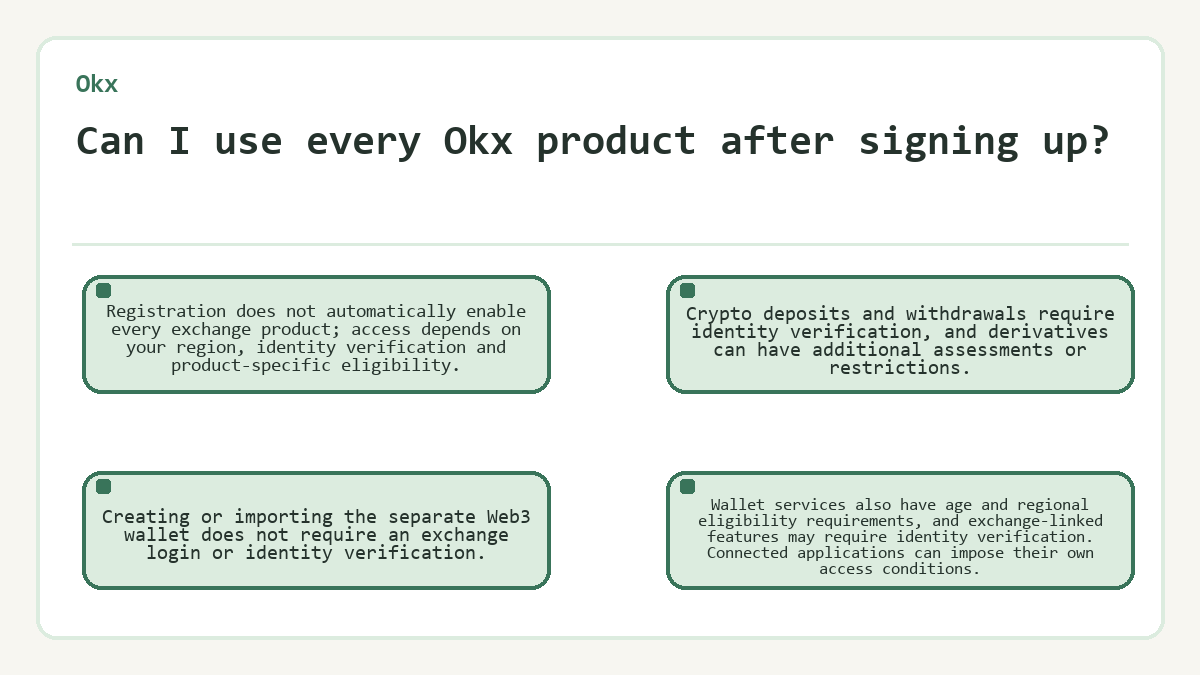
Can I use every Okx product after signing up?
Registration does not automatically enable every exchange product; access depends on your region, identity verification and product-specific eligibility. Crypto deposits and withdrawals require identity verification, and derivatives can have additional assessments or restrictions. Creating or importing the separate Web3 wallet does not require an exchange login or identity verification. Wallet services also have age and regional eligibility requirements, and exchange-linked features may require identity verification. Connected applications can impose their own access conditions.
Spot orders change holdings; derivatives change exposure
Spot trading exchanges one asset for another, changing the crypto balance you hold in the exchange account. The order book contains buy and sell offers for the selected market.
Market orders seek immediate execution against available offers. A limit order sets the highest acceptable buy price or lowest acceptable sell price. Matching liquidity determines whether it fills fully, partly or remains open. The last traded price does not guarantee the price of a new fill.
Margin trading adds borrowing to the transaction. Collateral supports the loan, borrowed assets create liabilities and interest adds a separate cost. Closing the trading exposure and repaying the borrowing are related obligations; a remaining liability still requires repayment.
Futures provide contractual exposure to price movements. Expiry futures have a settlement date, while perpetual futures have no fixed expiry and can involve funding payments. Leveraged positions need margin, and insufficient margin can trigger liquidation. Cross margin shares eligible collateral across positions, while isolated margin assigns collateral to an individual position under the applicable account rules.
Options introduce a premium, strike price and expiration date. The buyer acquires contract rights; the seller takes on the corresponding settlement obligation. These products have different payoff structures from spot holdings. Access to one instrument does not establish eligibility for another.
Trading fees and execution costs follow the route
The cost of an exchange trade reflects its execution method and the fee schedule applicable to your account. An immediately matching limit-order fill receives taker treatment. An order resting on the book can instead receive maker treatment when subsequently matched. Product, market and account tier affect the applicable rate.
Buy, sell and Convert flows can present an all-in quote, so an advertised absence of a separate trading fee does not establish identical buy and sell prices. Order-book trading also has a spread between available offers. A larger order may fill at several prices. Borrowing interest, perpetual funding and withdrawal charges belong to separate activities, making a spot fee alone an incomplete estimate of another product's costs.
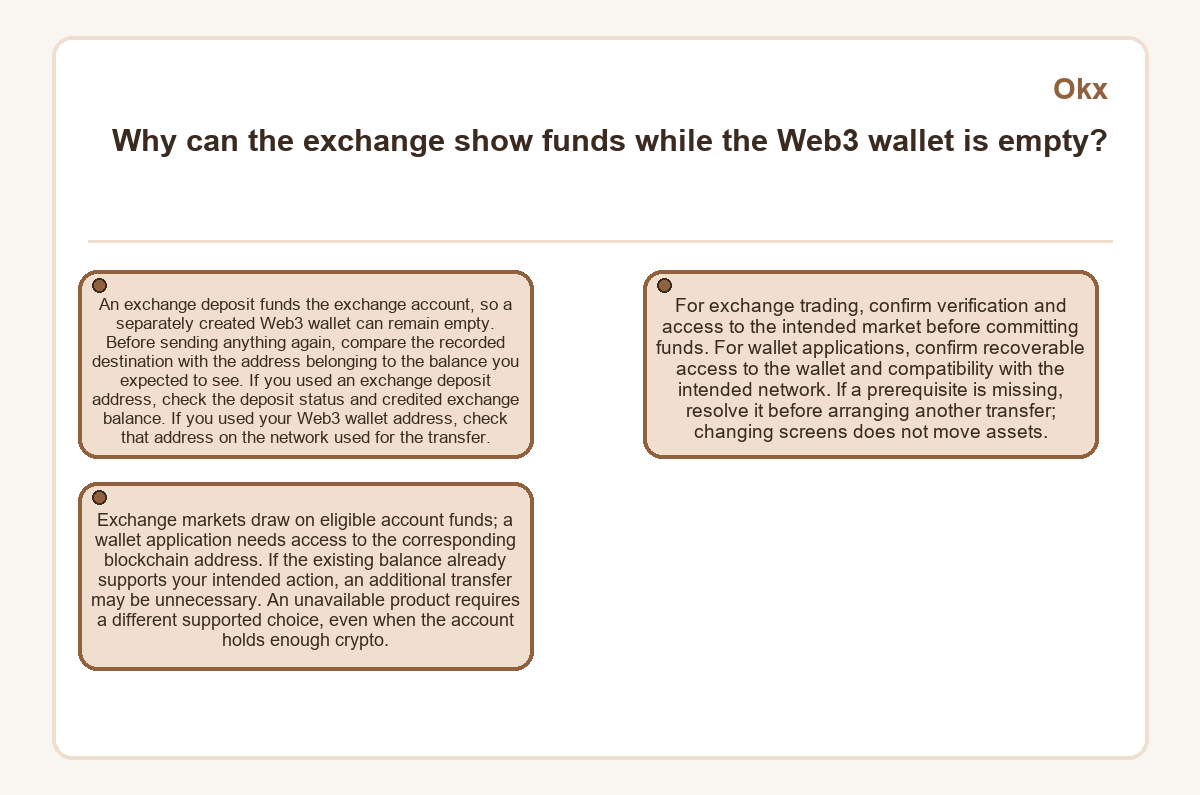
Why can the exchange show funds while the Web3 wallet is empty?
An exchange deposit funds the exchange account, so a separately created Web3 wallet can remain empty. Before sending anything again, compare the recorded destination with the address belonging to the balance you expected to see.
- If you used an exchange deposit address, check the deposit status and credited exchange balance.
- If you used your Web3 wallet address, check that address on the network used for the transfer.
- For exchange trading, confirm verification and access to the intended market before committing funds.
- For wallet applications, confirm recoverable access to the wallet and compatibility with the intended network.
- If a prerequisite is missing, resolve it before arranging another transfer; changing screens does not move assets.
Exchange markets draw on eligible account funds; a wallet application needs access to the corresponding blockchain address. If the existing balance already supports your intended action, an additional transfer may be unnecessary. An unavailable product requires a different supported choice, even when the account holds enough crypto.
What does the Web3 wallet connect to?
The Web3 wallet connects self-custodied assets with decentralized exchanges, blockchain applications and supported digital collectibles. Its decentralized exchange (DEX) aggregator searches liquidity across integrated venues, and cross-chain tools support transfers between compatible networks. DeFi, short for decentralized finance, includes application-based lending and staking. Non-fungible tokens (NFTs) represent individually identifiable tokens. The wallet's broader network support does not imply every application supports those same networks. Exchange listings and assets available through wallet tools also form different sets.
Networks, permissions and recovery govern wallet transactions
A wallet can display assets across supported networks, while each transaction follows the rules of its own blockchain. Matching a token name does not establish deposit compatibility. An exchange deposit also needs support for the particular asset and network. Deposits below the stated minimum are not credited. The required confirmations determine when a supported deposit becomes available.
Wallet swaps can involve network execution costs, often called gas, alongside route-specific service charges. Estimated output can change with liquidity and price movement; a cross-chain route adds the requirements of the selected bridge. Token approvals can authorize a contract to spend specified tokens. An approval's recipient and scope matter because that permission can enable subsequent spending. Activity on a public blockchain can also expose address balances and transaction history.
For a seed-phrase or private-key wallet, recovery requires retaining the applicable backup. Anyone possessing a wallet's recovery phrase can control its assets. The local wallet password protects access on the device and has a different function from the recovery phrase. An exchange password reset cannot replace that backup. Passkey-based smart-contract wallets use different recovery arrangements, so their requirements should not be inferred from a seed-phrase wallet.
Bots, copy trading and Earn change asset commitments
Trading bots execute orders under configured rules; a spot grid bot places orders within a selected price range. Copy trading follows a lead trader's activity, subject to available funds and risk limits. Copy orders can fail when those conditions are unmet. Executed trades incur the applicable trading fees, and copy trading can add profit sharing. Automation changes order handling while leaving exposure to unfavorable price movements.
Simple Earn Flexible pools crypto for lending and distributes borrower interest after service fees. Redemption can be restricted when the affected pool lacks liquidity. For a fixed-term subscription, the portion matched and drawn down by borrowers cannot be redeemed during its term; repayment delays can extend the lock. An undrawn order can be redeemed only in full. Simple Earn does not protect principal against loss. Wallet-based DeFi has separate protocol and transaction requirements; a similar yield label does not establish equivalent terms.
Account security and reserve reports cover different risks
Exchange authentication protects account access and withdrawal requests. A unique password and two-factor authentication (2FA) reduce exposure to stolen login credentials. An address allowlist restricts withdrawal destinations, while security-setting changes can temporarily suspend withdrawals. A visible balance is consequently different from an immediately withdrawable balance. API access supports software-based trading and account operations; its granted permissions determine what connected software can do.
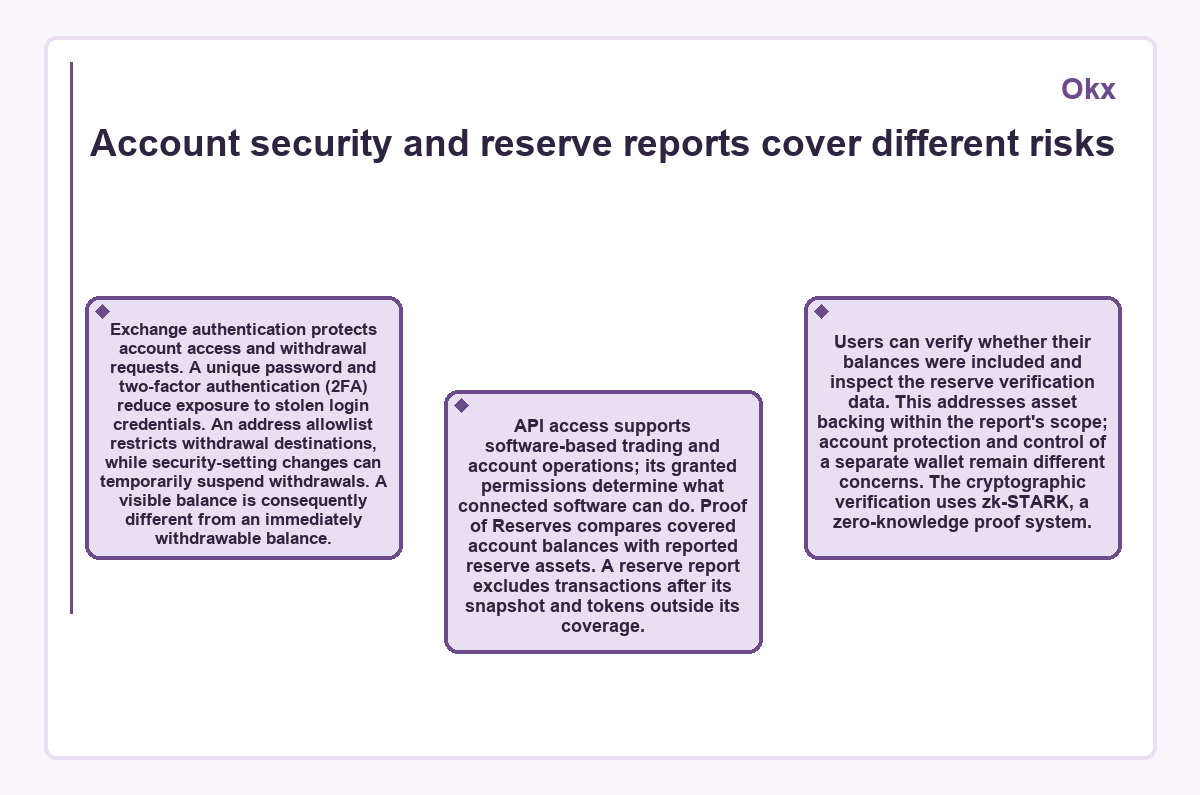
Proof of Reserves compares covered account balances with reported reserve assets. A reserve report excludes transactions after its snapshot and tokens outside its coverage. Users can verify whether their balances were included and inspect the reserve verification data. This addresses asset backing within the report's scope; account protection and control of a separate wallet remain different concerns. The cryptographic verification uses zk-STARK, a zero-knowledge proof system.
Helpful answers about Okx
Is demo trading available without committing real funds?
Demo trading uses virtual assets for practice orders without changing your real holdings. It is a separate trading environment, so simulated balances do not represent withdrawable money. Its usefulness is learning order handling and exploring supported instruments; a simulated outcome does not establish the outcome of a live trade.
Does a referral code guarantee a signup reward?
A referral code alone does not guarantee a reward. Exchange campaigns can require an eligible new account, identity verification and specified tasks within the event period. Referral relationships are established during registration. The offer attached to the account governs its reward conditions, rather than a discount or bonus advertised elsewhere.
Which devices support the Web3 wallet?
The Web3 wallet is available on iOS, Android and web browsers. Device availability does not establish that every wallet mode or connected application has identical requirements. Exchange-linked passkey wallets have additional device and account prerequisites, while a separate seed-phrase wallet uses its own backup and access credentials.
What happens if I deposit an unsupported token?
An unsupported deposit can fail to credit or appear as an untradable asset. Some untradable assets qualify for withdrawal through a supported recovery route, while others need support review. Recovery depends on the asset and network involved. A blockchain confirmation alone does not make the deposit usable for exchange trading.
How long does a password-change withdrawal lock last?
Changing an exchange login password can trigger a 24-hour withdrawal security hold. The restriction shown on the account identifies the applicable lock. Other barriers, including incomplete verification, maintenance or a risk-control restriction, can remain afterward. The exchange hold does not alter the keys of a separately controlled Web3 wallet.
Do deposits always need a memo or tag?
A memo or tag is required when the receiving platform specifies one for the selected asset and network, because a shared deposit address may need that extra identifier to assign funds to your account, and an omitted or incorrect identifier can prevent crediting.
Can I restore a cloud-backed wallet with just my exchange password?
Restoring an encrypted cloud backup requires its backup password, which differs from the wallet password and exchange login credentials. You also need access to the cloud account holding the backup. Losing that password without retaining the recovery phrase or private key leaves the encrypted backup unable to restore the wallet.
Why must P2P sellers check their receiving account before releasing crypto?
A buyer's paid status does not establish that money has reached the seller's receiving account. Crypto release must follow confirmation of payment in that account. Buyer-supplied screenshots can be faked, and the payer's name must match the verified buyer. Missing payment calls for the order's dispute process while crypto remains unreleased.