 Okx
Okx
Okx trading fees depend on the product, account tier and executed fills
Okx trading fees are charges on executed trades, with rates determined by the product, account tier and maker or taker role. A mismatch between an expected charge and your balance can also involve execution prices, fee currencies or separate funding payments. Compare completed fills with the corresponding account movements.
In short: A spot purchase's net receipt reflects its filled quantity minus fees charged in the same asset.
Cost drivers enter at different points in a trade
The account rate sets the starting fee estimate, while execution determines the amount the exchange actually charges. Product choice matters before an order reaches the market. A spot order book trade has maker and taker rates; Buy and Sell or Convert can quote a price with a spread built into it. Applying an order book rate to that quote mixes different pricing methods.
At execution, the filled quantity, execution price and liquidity role determine the relevant calculation. Afterward, the fee currency explains which balance reflects the deduction. An open position can generate further costs, including applicable funding or borrowing charges. A change in available balance can also reflect funds reserved for open orders, so it does not by itself establish a paid fee.
A limit order can contain maker and taker fills
Maker and taker describe how an order interacts with existing liquidity when it fills. An order resting on the book supplies liquidity. An execution against an existing order takes liquidity and uses the taker rate.
A limit price controls the acceptable execution price; it does not guarantee maker classification. An immediately executable limit order can incur taker charges.
One limit order can also contain both roles. Its immediately matched portion takes liquidity, while a remaining portion can rest and later fill as maker. Separate fills therefore matter when explaining an aggregate fee. Assigning one rate to the original order quantity can misstate both the charged amount and the completed trade size.
Post-only instructions restrict an accepted order to maker execution where the market supports that instruction. An order that would immediately match is cancelled. This controls the liquidity role, but execution still requires a later matching order. The order can remain unfilled if no matching order arrives at its limit price.
Spot receipts and contracts use different fee bases
A positive fee on a spot purchase charged in the purchased asset equals filled asset quantity multiplied by the applicable rate. Subtracting that fee explains the net quantity received. For a sale charged in the proceeds currency, apply the rate to the filled sale value in that currency. The fee unit must match the amount used in the calculation.
Futures trading fees apply to the executed contract value. Posted margin supports the position and has a different purpose. Comparing the fee with margin alone can make the effective percentage look unexpectedly large. Opening and closing executions each have their own filled size, price and liquidity role.
For linear, stablecoin-margined futures, the fee basis uses contract count, contract size, multiplier and fill price. For inverse, crypto-margined futures, it uses contract count, multiplier and face value divided by fill price. The second calculation expresses the basis in the settlement asset. Substituting the linear formula into an inverse contract produces incompatible units.
Options use a separate fee calculation with a cap tied to the option premium. Contract size, multiplier and executed quantity also matter. The premium paid for an option and the trading fee are distinct costs. Exercise or settlement can carry additional product-specific charges, so a completed options fill does not necessarily represent every cost of holding that contract.
Fees charged in the purchased asset reduce the spot receipt
A completed spot purchase can credit fewer asset units than its gross filled quantity because the fee is deducted from those units. This reconciliation applies when the recorded fee uses the purchased asset and represents a charge. A conversion quote, a derivatives settlement or a rebate in another currency needs its own calculation.
| Reconciliation stage | Mismatch this stage can expose |
|---|---|
| Identify the completed spot purchase | An instant conversion quote or a contract trade uses different cost inputs from an order book spot purchase. |
| Match the account rate at execution | A public rate or today's tier may differ from the account rate applicable when the trade filled. |
| Separate the completed fills | The requested quantity can include an unfilled remainder, and individual fills can have different liquidity roles. |
| Read the fee amount with its currency | A deduction in another asset cannot be subtracted directly from the purchased asset quantity. |
| Correct the expected net receipt | Using gross filled quantity as the expected credit leaves the recorded fee inside the estimate. |
| Match the purchase with its balance entries | Later trades, deposits or withdrawals can make the present balance differ from this purchase's net increase. |
| Reconciled receipt | Completed purchase quantities minus recorded charges in the same asset explain the net receipt; unrelated account movements remain separate. |
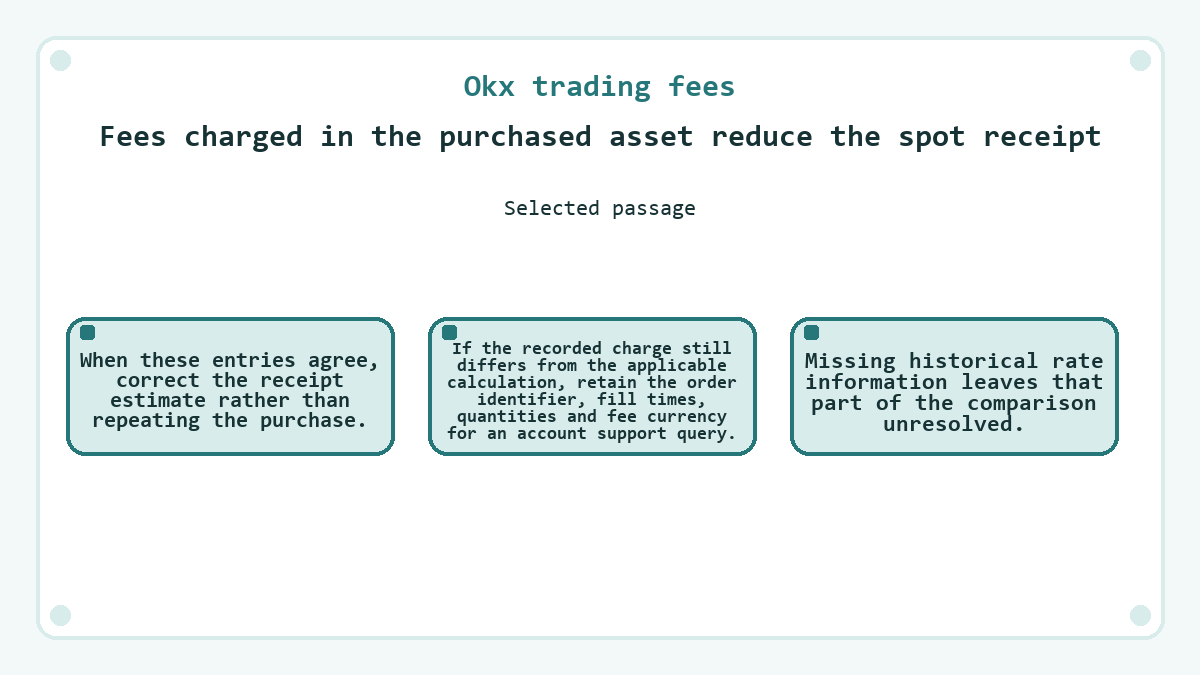
When these entries agree, correct the receipt estimate rather than repeating the purchase. If the recorded charge still differs from the applicable calculation, retain the order identifier, fill times, quantities and fee currency for an account support query. Missing historical rate information leaves that part of the comparison unresolved.
Account tiers explain changes between trading days
Fee tiers use qualifying trading volume and account assets under the schedule applicable to the account. VIP eligibility can follow either the schedule's rolling volume criteria or its asset thresholds. The logged-in fee screen shows the qualifying window and applicable rates; tier updates do not happen with every fill. Regional schedules can also distinguish account setups, including derivatives account status. A newer tier cannot explain a historical charge unless it applied when that execution occurred.
Funding and borrowing charges have separate triggers
Funding is a position-holding payment for applicable futures contracts, exchanged between long and short holders. Positive funding sends payment from longs to shorts; negative funding reverses that direction. Liability depends on holding the position at the actual assessment point. The contract's displayed rate and settlement schedule govern that payment, and the schedule can change with market conditions.
Borrowing interest follows an interest-bearing liability under the relevant account and margin rules. A margin trade can therefore have both an execution fee and borrowing interest. Interest-free allowances for particular futures liabilities do not establish an allowance for a margin loan. Borrowing records identify the liability and interest charge; the maker or taker rate cannot explain that separate deduction.
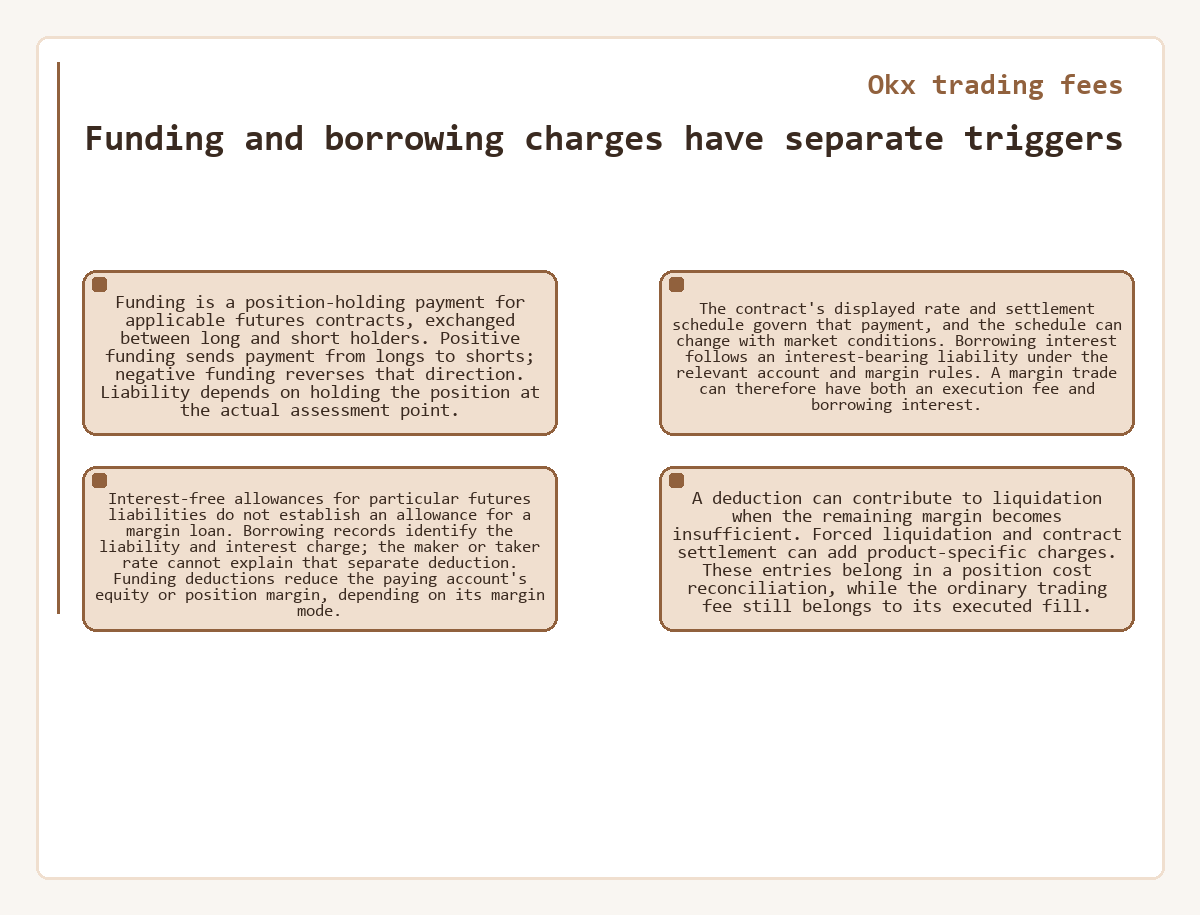
Funding deductions reduce the paying account's equity or position margin, depending on its margin mode. A deduction can contribute to liquidation when the remaining margin becomes insufficient. Forced liquidation and contract settlement can add product-specific charges. These entries belong in a position cost reconciliation, while the ordinary trading fee still belongs to its executed fill.
Execution prices complete the cost comparison
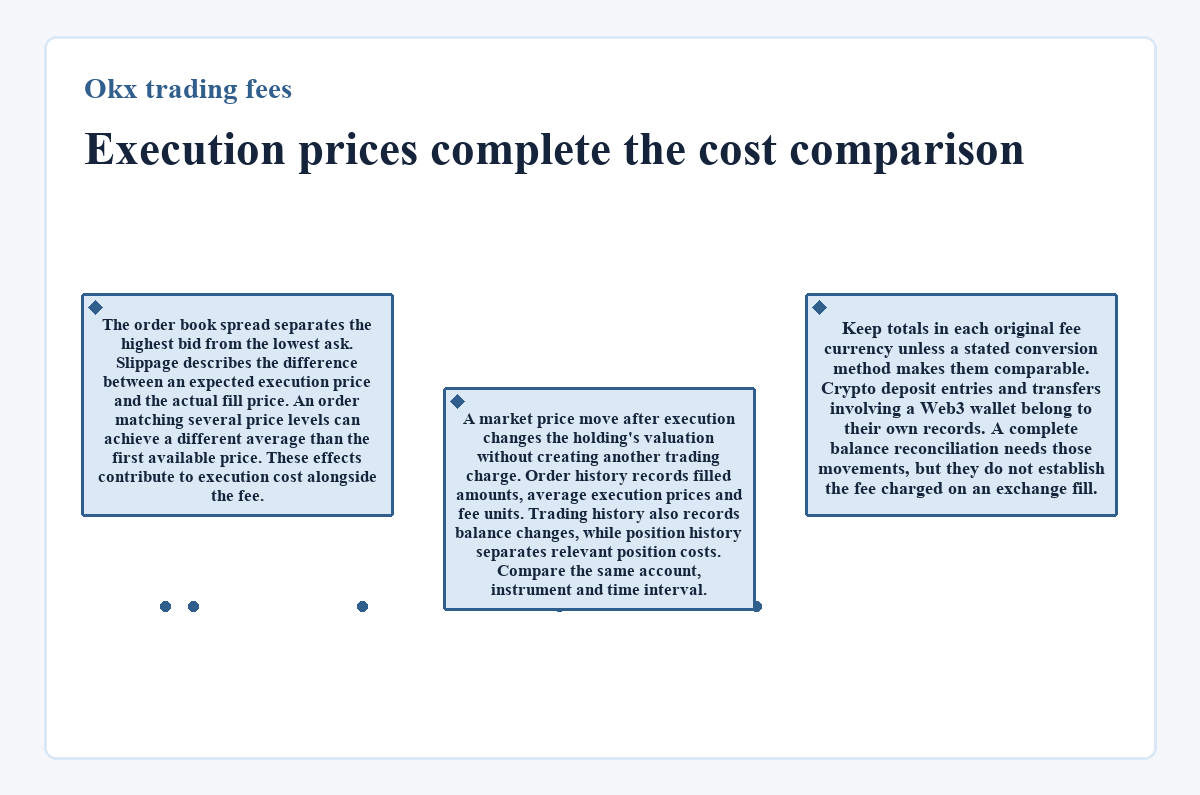
The order book spread separates the highest bid from the lowest ask. Slippage describes the difference between an expected execution price and the actual fill price. An order matching several price levels can achieve a different average than the first available price. These effects contribute to execution cost alongside the fee. A market price move after execution changes the holding's valuation without creating another trading charge.
Order history records filled amounts, average execution prices and fee units. Trading history also records balance changes, while position history separates relevant position costs. Compare the same account, instrument and time interval. Keep totals in each original fee currency unless a stated conversion method makes them comparable. Crypto deposit entries and transfers involving a Web3 wallet belong to their own records. A complete balance reconciliation needs those movements, but they do not establish the fee charged on an exchange fill.
Things people ask about Okx trading fees
Can cancelling an order refund fees from its completed fills?
Cancelling an unfilled remainder does not reverse completed fills or their trading fees. Cancellation itself carries no trading fee for the unfilled quantity, and it releases funds reserved for that remainder. An opposite trade creates a new execution with its own price and charges; it does not erase the earlier fee.
Does changing leverage create an extra trading fee?
Changing leverage alone does not incur a trading fee. Adding or removing isolated margin also carries no fee by itself. A new order fill has its own charge based on the executed size and applicable rate.
Why does my API fill show a negative fee amount?
In the API fill record, a negative fee amount represents a deduction and a positive amount represents a rebate. Read the amount together with its fee currency. This convention describes that record field; a published fee schedule can use a negative rate to indicate a maker rebate, so the signs need their own context.
Can a referral rebate appear after the full trading fee?
An eligible affiliate rebate can be credited separately after the standard trading fee is charged. The original fill may therefore show the full charge even when a rebate applies. Eligibility, covered products and the rebate share follow the account's program terms. When totaling costs, include a credited rebate for the relevant trades using matching currency units; an advertised percentage alone does not establish entitlement.
What makes a fee-free trade ineligible for VIP volume?
The applicable tier rules can exclude zero-fee spot pairs from qualifying trading volume. In that case, an executed trade increases activity without increasing the volume used for the tier calculation. Promotional campaigns can have separate eligibility rules. The relevant distinction is whether that market's volume qualifies, not simply whether an order completed.
Is a card issuer's charge included in the maker or taker fee?
A card issuer or payment provider can charge separately from the exchange's maker or taker fee. That charge follows the payment method's terms. Keep it separate from the commission recorded against an order book fill.
How do bot profit figures relate to the fees on individual fills?
A bot's reported profit follows its strategy accounting and is not a total of trading fees. Fill history identifies the executed trades and their charges. A fee total needs records for the same period and compatible currency units. Stopping or deleting a bot does not remove previously recorded trades.